
The Union Budget is announced every year, offering a glimpse into the government’s economic vision, and similarly, the Union Budget 2026 was no exception.
Nirmala Sitharaman, Union Finance Minister, announced the Union Budget 2026-27 on 1st February 2026. The budget announced this year turned out to be a blueprint of how the government wants the next stage of development in India to be. The budget was billed as a Yuva Shakti budget with a focus on the young citizens.
The Union Budget 2026-27 was classified into three different kartavya- or responsibilities that guided the government in the way it is conducting its taxation and infrastructure, education, manufacturing, healthcare, technology, and various other social aspects.
It is grounded on three different Kartavya or responsibilities that guide the government in the way it conducts its taxation, infrastructure, manufacturing, education, healthcare, technology, and social aspects.
The resolve of the government has been to put the poor, the underprivileged, and the disadvantaged classes of society to the forefront and, at the same time, make India capable of meeting the challenges of the unpredictable global environment.
The Union Budget 2026 aims at creating a balance between economic growth and fiscal responsibility, as well as convenience in governance.
What are the three Kartavya that shape the Union Budget 2026?
As per the announcement made by Finance Minister Nirmala Sitharaman, the budget is inspired mainly by three kartavya, representing the economic and social priorities of the government.
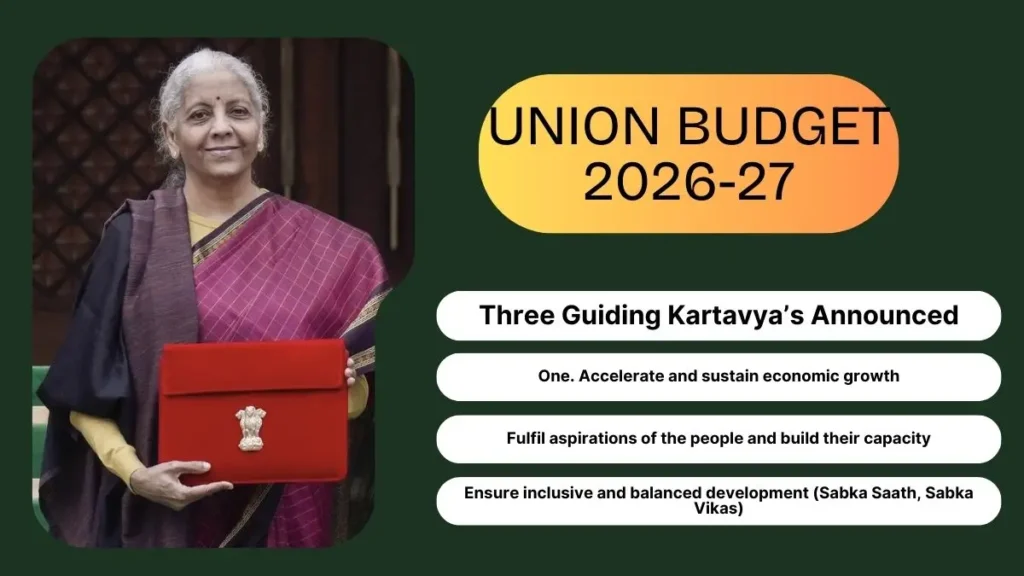
- Kartavya One for the Growth and Development of Economic Growth
When talking about the Kartavya one, it is very important to note that it is aimed at maintaining the high rate of economic growth. In addition to this, it also focuses on enhancing productivity, increasing competitiveness, and creating resilience. The Budget acknowledges that world trade is being threatened, supply chains are being stressed, and energy and precious mineral availability are becoming unpredictable.
The Union Budget 2026 intends to prepare India for these challenges and mitigate the national demand by increasing government outlay on the people, promoting manufacturing and export-driven growth.
- Kartavya Two for Aspirations and Capacity Building
If we look at the second kartavya, it is solely focused on individuals. The budget through this initiative intends to increase access to education, healthcare, tourism, housing, and sports. Interestingly, the government has also emphasized that more than 25 crore individuals have lifted themselves out of multidimensional poverty in the last ten years as a result of perpetuated reforms.
This section of the Union Budget 2026 gives priority to the youth, women, students, and individuals seeking jobs.
- Kartavya Three: Sabka Sath, Sabka Vikas
The third Katravya is aligned with the vision of Sabka Stah, Sabka Vikas. As the name itself suggests, this aim if for ensuring that growth reaches every region and individual. Farmers, Divyangjan, vulnerable groups, Purvodaya states, and the North-east receive targeted attention under the Union Budget 2026.
The Development of Manufacturing and Industrial Growth Under Union Budget 2026-27
The manufacturing sector remains at the centre of India’s long-term economic strategy. The budget here proposes focused intervention for strengthening the domestic industry and reducing external dependence.
Advancing Strategic and Next-Generation Manufacturing
With the announcement of the Union Budget 2026-27, the government has also laid plans for scaling manufacturing in seven strategic sectors. In continuation of this, the sector- specific details will be announced later. The goal here is very clear: to strengthen supply chains, improve technology adoption, and integrate India deeper into global value chains.
Biopharma SHAKTI: Strengthening Healthcare Manufacturing
For upscaling the global biopharma manufacturing hub of India, the Union Budget 2026 made an announcement for Biopharma SHAKTI with an outlay of ₹10,000 crore over five years.
The initiative included the following:
- Three new National Institutes of Pharmaceutical Education and Research (NIPERs)
- Upgrading seven existing NIPERs
- A network of over 1,000 accredited clinical trial sites
- Strengthening CDSCO with scientific review specialists
This move supports domestic production of biologics and biosimilars while improving regulatory efficiency.
Textile Sector: Jobs, Sustainability, and Scale
Recognising textiles as a labour-intensive sector, the Budget introduces an integrated programme covering:
- National Fibre Scheme for natural and man-made fibres
- Textile Expansion and Employment Scheme for cluster modernisation
- National Handloom and Handicraft Programme
- Tex-Eco Initiative for sustainable textiles
- Samarth 2.0 for industry-linked skilling
The focus remains on employment generation and global competitiveness
MSMEs and SMEs: Building India’s Next Growth Champions
The Union Budget 2026 reinforces the role of MSMEs as engines of growth. A ₹10,000 crore SME Growth Fund is proposed to support enterprises that demonstrate potential for scale, innovation, and job creation.
By incentivising performance and formalisation, the fund aims to help MSMEs adopt technology, improve productivity, and access larger markets.
Infrastructure Push Continues With Higher Public Capex
Public investment continues to anchor the growth strategy.
- Public capex in FY 2025-26: ₹11.2 lakh crore
- Proposed capex in FY 2026-27: ₹12.2 lakh crore
This sustained increase supports construction, logistics, manufacturing, and employment.
Freight Corridors and Inland Waterways
To promote greener cargo movement, the Budget proposes:
- New Dedicated Freight Corridors from Dankuni to Surat
- Operationalising 20 new National Waterways over five years
- Launching NW-5 in Odisha to link mineral-rich regions to ports
Training institutes will support skilled manpower for these logistics networks.
High-Speed Rail as Growth Connectors
Seven high-speed rail corridors will be developed:
- Mumbai–Pune
- Pune–Hyderabad
- Hyderabad–Bengaluru
- Hyderabad–Chennai
- Chennai–Bengaluru
- Delhi–Varanasi
- Varanasi–Siliguri
These corridors aim to reduce travel time and promote regional growth.
City Economic Regions: A New Model for Urban Development
The Union Budget 2026 introduces City Economic Regions (CERs) based on local growth drivers. Each CER will receive ₹5,000 crore over five years, allocated through a reform-linked challenge mode.
This model encourages states and cities to plan development based on economic strengths rather than administrative boundaries.
Education, Skills, and Youth Empowerment
Human capital development remains a strong pillar of the Budget.
AVGC Content Creator Labs
The Indian Institute of Creative Technologies, Mumbai, will set up:
- AVGC labs in 15,000 secondary schools
- AVGC labs in 500 colleges
This supports a sector expected to employ 2 million professionals by 2030.
Girls’ Hostels in Every District
To address challenges faced by girl students in STEM institutions, the Budget proposes one girls’ hostel in every district, supported through viability gap funding or capital support.
Tourism and Hospitality Skill Development
The government will:
- Upgrade NCHMCT into a National Institute of Hospitality
- Upskill 10,000 tourist guides across 20 destinations
- Offer a 12-week hybrid training programme with an IIM
This supports tourism-led employment and service quality.
Sports Development Through Khelo India Mission
The Khelo India Mission will guide sports development over the next decade. The mission focuses on:
- Talent identification and development pathways
- Training of coaches and support staff
- Integration of sports science and technology
- Competitive leagues and tournaments
- Sports infrastructure for training and events
The aim is to build a sustainable sports ecosystem.
Agriculture, Rural Growth, and Women-Led Enterprises
Bharat-VISTAAR: AI for Farmers
The Budget introduces Bharat-VISTAAR, a multilingual AI platform that integrates AgriStack portals and ICAR practices. The system will offer customised advice, reduce risk, and improve farm productivity.
Strengthening Self-Help Groups
Building on the Lakhpati Didi programme, SHE Marts will be set up as community-owned retail outlets to help women-led SHGs access markets and finance.
Healthcare, Medical Tourism, and Mental Health
Medical Tourism Hubs
Five regional medical hubs will be developed with private sector participation. These hubs will combine healthcare services, education, research, AYUSH centres, diagnostics, and rehabilitation.

Mental Health Infrastructure
The government will set up NIMHANS-2 and upgrade mental health institutes in Ranchi and Tezpur, strengthening access to trauma and mental health care.
Direct Tax Reforms in Union Budget 2026
New Income Tax Act from April 2026
The New Income Tax Act, 2025, will come into force from April 2026. Simplified rules and redesigned forms aim to improve compliance and reduce disputes.
Relief and Simplification for Taxpayers
Key proposals include:
- Revised return deadline extended to 31 March
- Lower TCS on overseas travel, education, and medical expenses
- Automated lower or nil TDS certificates
- One-time 6-month foreign asset disclosure scheme for small taxpayers
Rationalising Penalties and Reducing Litigation
The Budget proposes:
- Single orders for assessment and penalty
- Reduced pre-deposit for appeals
- Updated returns even after reassessment
Minor offences are decriminalised to promote trust and voluntary compliance.
IT Sector and Global Investment Incentives
Unified IT Services Framework
All IT-related services will be grouped under a single category:
- Safe harbour margin of 15.5%
- Threshold increased to ₹2,000 crore
- Five-year continuity
Attracting Global Businesses
The Union Budget 2026 offers:
- Tax holiday till 2047 for foreign cloud providers using Indian data centres
- MAT exemption for non-residents under presumptive taxation
- Safe harbour for bonded warehousing
These measures strengthen India’s appeal as a digital and logistics hub.
Indirect Taxes, Customs, and Trade Facilitation
Customs reforms aim to simplify trade and reduce costs:
- Duty exemption for lithium-ion battery manufacturing equipment
- Exemption for critical mineral processing machinery
- Customs duty exemption for 17 drugs and medicines
- Personal import duty reduced from 20% to 10%
Customs processes will rely more on digital systems and risk-based audits.
Fiscal Discipline and Economic Outlook
The government maintains its commitment to fiscal consolidation:
- Fiscal deficit FY 2026-27: 4.3% of GDP
- Debt-to-GDP ratio: 55.6%
Lower debt levels will create more room for future development spending.
Conclusion: What the Union Budget 2026 Means for India
The Union Budget 2026 presents a steady and reform-oriented approach to governance. It combines infrastructure investment, tax simplification, digital systems, and targeted welfare measures. Youth, women, MSMEs, and emerging regions receive strong focus.
While global uncertainty remains, the Budget reflects confidence in India’s growth trajectory and reinforces the long-term vision of Viksit Bharat through inclusion, resilience, and capacity building.